
The Recognition
Market
Identity. Honor. Memory.
Built on what was earned, not what is bought.
Service members earn recognition through service, mentorship, sacrifice, and the time they put in. The Recognition Market is the system that makes that recognition durable, portable, and verifiable — without ever putting a dollar sign on it.
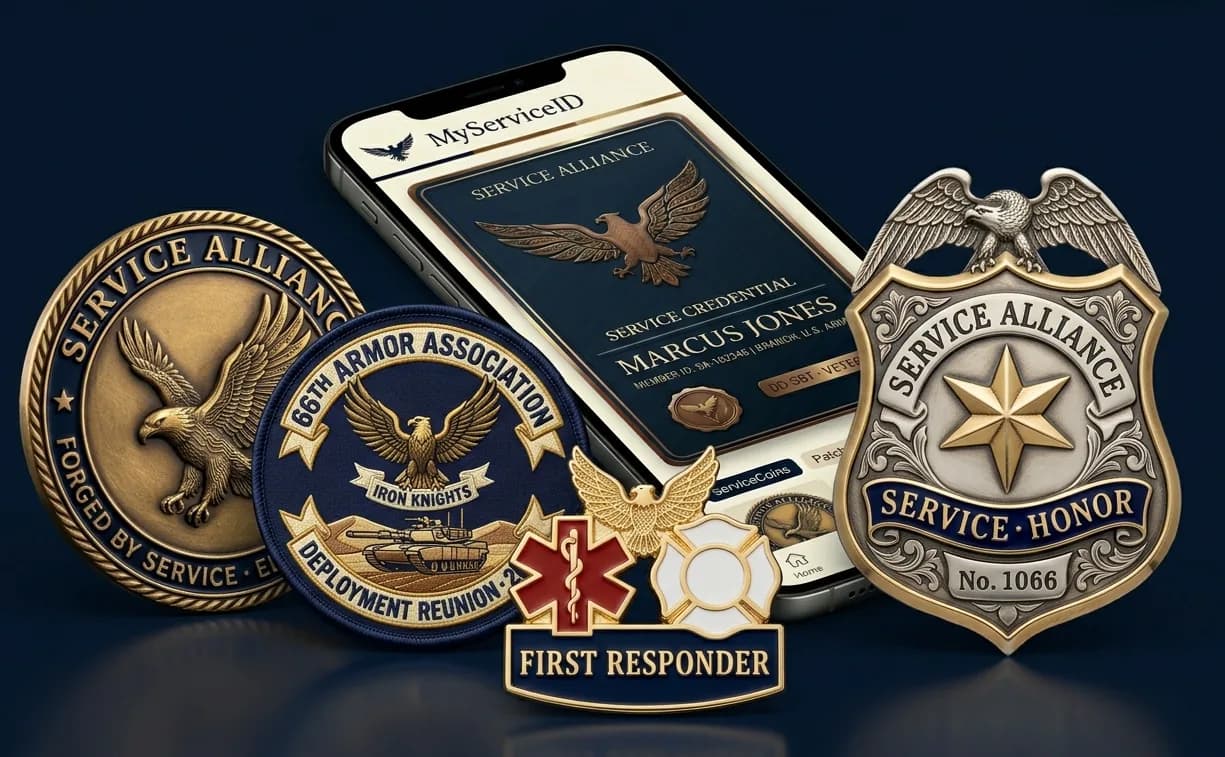
The Tradition
You have always worn your service.
Now it travels with you.
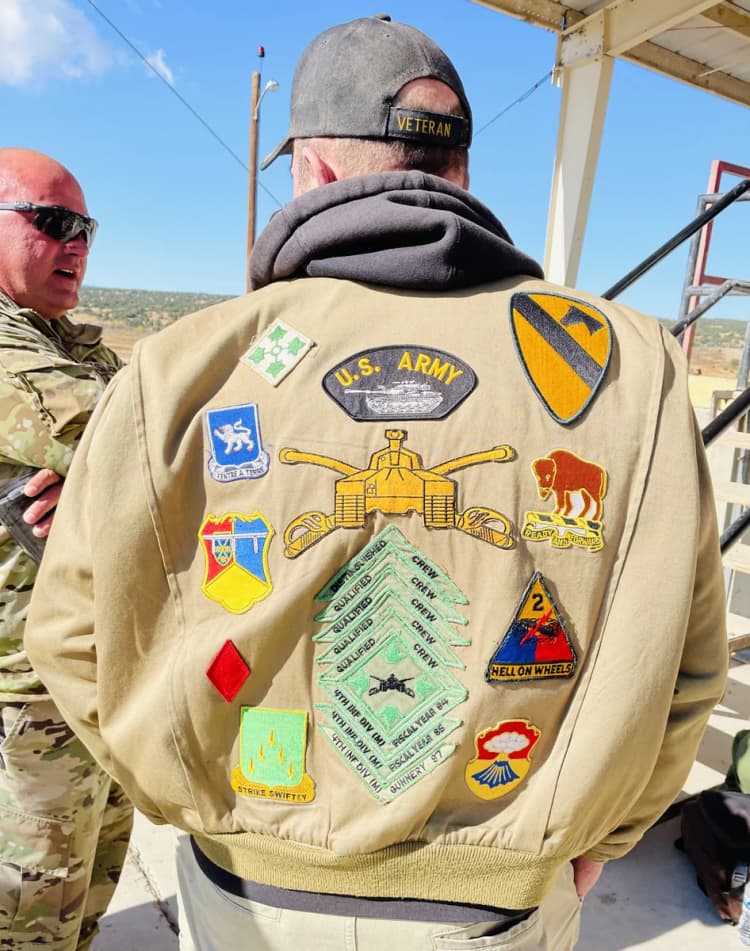
Unit patches, qualification badges, crew certifications, division crests — a lifetime of service carried on a bomber jacket. Every patch is a story. Every badge is something earned in the field, not given at a desk.
The Recognition Market is the digital form of what Veterans have always done naturally: collect and display the record of where they served, what they qualified for, and who they served beside. The same objects. The same meaning. Now verified, portable, and permanent — starting from the day you raise your right hand, not the day you separate.
How It Works
Three things, one identity.
Service Alliance's Recognition Market has three building blocks. They work together. Each one does something the others can't.
MyServiceID
Who you are. Verified once. Yours forever.
- —Begins in active service — the AS-SBT accumulates your record while you are still in uniform. At separation, it converts one-way to your permanent credential: DD-SBT for Veterans, LE-SBT, FFR-SBT, FED-SBT, or PSP-SBT for other domains.
- —Soulbound — cannot be sold, transferred, or faked. It is yours for life.
- —Read by every tool in the Service Alliance platform and by partner organizations who need to verify your service
- —One wallet. Five domains. Zero re-verification.
ServiceCoins
Recognition you can give and receive.
- —Earned through milestones, mentorship, and peer acknowledgment
- —Gifted by your unit association, your local, your lodge, or by other members
- —Spent inside the Recognition Market — on patches, pins, badges, platform credits, and minting fees
- —Never sold for dollars. Never cashed out. The recognition is the value.
ServicePatches · ServicePins · ServiceBadges
What you collect. What you trade. What stays.
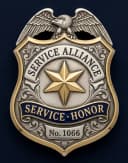
- —Three expression assets — patches (unit and event commemoratives), pins (lapel and hat pin tradition), badges (tabs, rockers, qualification badges) — identical exchange value, fully tradeable
- —Earn through participation, trade peer-to-peer, or purchase with ServiceCoins inside the Recognition Market
- —Separate credential variants — Certification Patches and Affiliation Badges — are soulbound and cannot be transferred, proving what you did, not just what you have
- —Order a physical embroidered or struck version through an authorized maker — digital and analog tradition together

Designed With You
The agent that knows your unit.
Most recognition systems assume the organization or the member already has a designer. Most do not. The Recognition Market is built for the way associations and members actually work — Patricia does not have a graphic designer on her board, and Marcus is not going to learn Photoshop to honor a brother he lost in 2009. So the platform brings the designer to them. Every ServiceCoin, ServicePatch, ServicePin, and ServiceBadge in the system can be designed in partnership with a Kinship Agent — an AI informed by the organization's history, the member's service record, and the visual traditions of the domain it serves.
Tell the agent what you want.
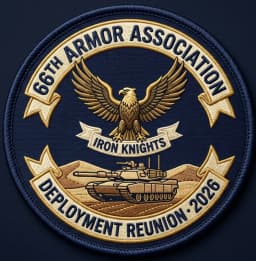
You describe the design in plain language. "A patch for our 2027 reunion — the bridge generation in Korea, our 66th Armored colors, the regimental crest, room along the bottom for the date." Or, "A coin for my friend Tom who died at FOB Lightning in 2009. He drove our maintenance truck. His call sign was Wrench." The agent listens. You do not need design vocabulary. You need the story.
The agent drafts. You decide.
The agent generates four to six candidate designs. Each one draws on the visual traditions of your domain — military heraldry for unit patches, fire service motifs for IAFF locals, law enforcement insignia for FOP lodges, the specific iconography that means something to the population the design is for. You pick the one that feels right. You ask for changes. You go again. The agent does not get tired and does not bill by the hour.
Issued under Service Alliance's authority.
When you approve the final design, the agent passes it through Service Alliance's alignment review — a step that screens for stolen valor, accidental copyright issues, and content that is not appropriate for the population the design serves. Once cleared, the digital ServicePatch, ServicePin, ServiceBadge, or ServiceCoin is issued under Service Alliance's authority, with your organization or your name as the co-signer. A permanent record captures who created it, when, and under what authority. The recognition is durable from the moment it exists.
Guardrails that match the population.
The agent is not a generic image generator. It has been built around what these communities actually need.
No stolen valor. The agent will not generate decorations, awards, or unit affiliations that the issuing organization is not authorized to represent.
No fabricated rank or insignia. Generative models hallucinate. The alignment pipeline checks rank, branch, and decoration depictions against verified reference sets before any design proceeds.
Memorialization handled with care. Designs honoring deceased service members or KIA references pass through a heightened review tier. Mistakes here are not just mistakes.
CJIS-aware for law enforcement. Designs in the law enforcement domain are screened against content that could be confused with restricted operational information.
Brand integrity for partner organizations. Each Issuer Member sets its own brand standards on onboarding. Agent-generated designs match.
Cultural fit for the domain. A patch for a Vietnam-era unit reunion does not look like a patch for a 2024 IAFF anniversary. The agent knows the difference.
Three ways to design.
Tell the agent what you want. The agent generates the design, you approve. This is how most personal commemoratives and most reunion patches will be created. Fastest path. Lowest skill barrier.
Upload your own design. If you have a designer in your association — Patricia's reunion patch was designed by a member who is a graphic designer — you can upload the finished art. The agent's role is to validate the file and run the alignment review. The design is yours; the platform issues it.
Hand-in-hand. Most designs in practice are co-creation. You sketch, the agent refines. The agent drafts, you redirect. The agent is a collaborator, not a replacement for your judgment. The designs that come out of this path are usually the ones members keep.
“Designs paid in ServiceCoins from the organization's treasury. The agent's work is part of the closed economy. No dollar enters the design step.”
In Practice
How the circle closes.
Recognition flows in a loop. The association invests in its members. The members strengthen the association. Here is what that looks like.
Patricia
Patricia is sixty-one and has served as president of the 66th Armored Association for eleven years — 2,400 members, twenty-one years of unit history, a website on a content management system that is shutting down in nine months. She has tried five other platforms. None of them understood what she was trying to preserve. The 66th Armored onboards as a Founding Member of the Recognition Market. The association pays its subscription. ServiceCoins flow into its treasury. Patricia is no longer fighting her infrastructure. She is running her association.
Marcus
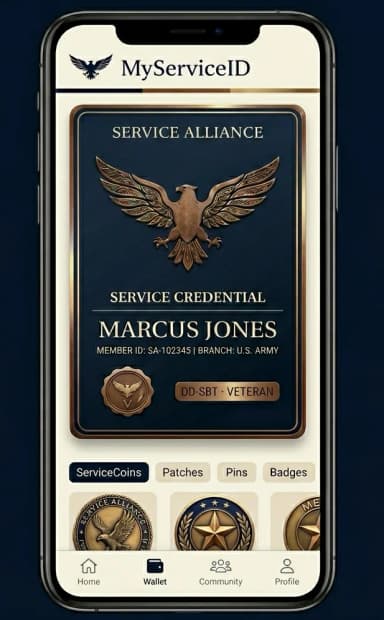
Marcus is one of those 2,400 members. Fourteen years in the Army, separated as a senior NCO, has been a paid-up member of the 66th Armored since his first reunion. He gets a notification: his MyServiceID is being issued, verified through the VA, co-signed by the 66th Armored. The association sends him 100 ServiceCoins as a welcome — the same gesture they used to make with a paid-up membership card, now durable, now portable. Marcus has paid nothing.
Patricia
In the second month, Patricia commissions a 2027 Reunion patch — limited edition of 500, designed by a member who is a graphic designer. She issues the patches and pays a small issuance fee in ServiceCoins from the association treasury. The Coins recirculate through the system; the association's spend becomes the platform's recognition of the work. Marcus registers for the reunion and earns the digital patch automatically. He orders a physical embroidered version through the association's authorized maker — the patch is on his vest before the reunion weekend.
Marcus
Marcus joins The Forge as a mentor for transitioning soldiers. He earns a Forge Mentor patch sewn into his credential record — not a commemorative, a credential. His mentees see that he walked the road before saying he would walk it with them. As Marcus mentors more service members, more ServiceCoins flow to him as recognition. He spends some on a memorial patch for a brother he lost in 2009. He gifts some to a younger 66th Armored member who is just transitioning out.
Patricia
By the sixth month, the loop has closed. The 66th Armored is more active than it has been in years. Three Vietnam-era members who had stopped responding to anything have come back specifically to record their oral histories. Membership is up. Patricia is in conversations with forty other unit associations who have heard about the 66th Armored's migration. The association's subscription is funding the recognition that is bringing the association back to life.
The loop
No member has paid a dollar for any of this. The association pays a subscription. ServiceCoins flow from the association to its members. Members earn more Coins through what they contribute back. Patches mark the days that mattered. The recognition is what stays.
Legal Standing
The legal home for recognition.
Recognition that lasts has to live somewhere. Service Alliance operates as part of a member-governed organization registered in West Virginia — the legal home that holds the authority to issue and stand behind every credential in the Recognition Market.
What gives it standing.
Service Alliance gains real legal standing through a member-governed organization registered in West Virginia under a 2026 law (HB 5060). That standing carries the authority to issue credentials, sign agreements with partner organizations, and keep a permanent, auditable record of every credential, ServiceCoin, ServicePatch, ServicePin, and ServiceBadge — administered by Service Alliance for the service community.
Why it matters.
A recognition system without legal standing is a feature; one with legal standing is durable. Partner organizations sign with a counterparty whose mission matches theirs, the authority to issue credentials sits with a nonprofit rather than a private company's safe, and the record is permanent and auditable — not a marketing claim.
Who governs it.
During the first 24 months — the founding period — governance rests with Service Alliance and the founder. After the founding period, governance transitions to the Issuer Members: the partner organizations who signed on and remained active. Decisions about how the Recognition Market evolves are made by the people whose communities live inside it.
Closed Economy
No dollars in. No dollars out.
The Recognition Market is closed against the dollar in both directions. ServiceCoins cannot be bought. ServicePatches, ServicePins, and ServiceBadges cannot be sold for cash on this platform. What members earn here, they earn through service. What they trade, they trade with each other.
The reason for this is plain — the moment recognition has a price tag, it stops being recognition. Service Alliance is built around what was earned, not what was bought, and the closed-economy structure is how we keep that promise.
“ServiceCoins are earned, gifted, and spent inside the Service Alliance community. They are not for sale and they cannot be cashed out. The recognition is the value.”
How the marketplace works
Three trade types operate inside the Recognition Market: Coin-for-patch/pin/badge listings (members set prices in ServiceCoins), patch-for-patch barter (direct asset swaps between members), and multi-asset atomic swaps combining both. A small fee in ServiceCoins is taken on each trade — denominated entirely within the closed economy, never in dollars.
For partners and counsel
ServiceCoins do not interface with fiat exchanges. There is no platform-supported price discovery against U.S. dollars. The Recognition Market operates as a closed accounting system under Service Alliance's permanent record. Securities and money-transmitter analysis under separate counsel. The Founding is targeted for July 1, 2026.
Founding Members
Become a Founding Member of the Recognition Market.
Service Alliance launches July 1, 2026. The first cohort of Issuer Members joins at the Founding. We are looking for partner organizations — VSOs, unit associations, IAFF locals, FOP lodges, POST commissions, accredited program operators — who want to be among the first to issue credentials, distribute ServiceCoins, and host commemorative patches for their members. Founding Members shape the Recognition Market's earliest operating practices.
Founding Member FAQ
Founding Member FAQ.
What partner organizations and individual sponsors actually ask.
What is the registered organization behind Service Alliance's credentials, and how is it different from Service Alliance LLC?
Service Alliance's recognition layer is administered through a member-governed nonprofit organization registered in West Virginia. It holds the authority to issue credentials, sign Issuer Agreements with partner organizations, and maintain the permanent record for every MyServiceID credential, ServiceCoin, and ServicePatch on the platform. It is registered under a 2026 West Virginia law (HB 5060) and governed by its own written Bylaws.
Service Alliance LLC is the Sponsor: the company that built the platform, contributes the tools and brand, and provides operating support. It is a separate entity, with separate finances and separate governance. The registered organization exists exclusively for the mutual benefit of its members and the uniformed-service community it serves; under its Bylaws, surplus is reinvested in the mission and recirculated to members — never distributed as a dividend to an outside shareholder, because there are none.
The distinction matters: your members' credentials are issued under a nonprofit whose mission matches theirs, not under a private company that could be acquired, change ownership, or change its terms tomorrow. Service Alliance LLC builds and maintains the tools. The registered organization is the institution that stands behind the credentials those tools issue, administered by Service Alliance.
Where are the rules actually written down — and can we see them before we commit?
Yes. The organization is governed by a written set of Bylaws organized into articles covering its legal form and purpose, membership, the Founders Cohort, the Sponsor's role and its limits, the recognition economy, governance, the treasury, member conduct and disputes, identity and data, and amendment and dissolution. The Bylaws also carry the guiding creed — the Service Alliance M.I.S.S.I.O.N. values (Merit Over Marketing, Identity Sovereignty, Service Beyond Self, Security by Design, Intelligent Community, Operational Excellence, and No One Left Behind) — which serve as the interpretive lens for every provision. Where a provision is ambiguous, the Bylaws direct that it be read in favor of the member, the protection of the vulnerable, and the durability of the mission.
When does Service Alliance register, and what is our commitment as a Founding Member?
Service Alliance registers in West Virginia under HB 5060 on or around July 1, 2026, and the first members admitted during the founding period form the Founders Cohort defined in the Bylaws. The 2026 West Virginia law requires the organization to maintain at least one hundred members at all times; the Founders Cohort is built to meet and exceed that floor at formation, which is why the founding period matters and why the earliest seats carry the standing they do.
A Founding Member's commitment is to participate in good faith — to uphold the M.I.S.S.I.O.N. values, recruit and welcome eligible members honestly, support member wellbeing (including familiarity with the Safe Harbor crisis-support pathway), and take part in governance. There is no minimum issuance volume required during the founding period.
In return, Founders carry heightened governance standing during the formative period, may help seat the founding council that stewards the organization's earliest policies, and receive a non-transferable Founder recognition mark recorded in MyServiceID. The Bylaws are explicit on one point: Founder status is a membership and stewardship role, not an investment. It attaches to the person or organization, is not transferable, is not a security, and confers no equity in Service Alliance LLC or any other entity. If your organization wants the credential but not the governance responsibility, the standard Issuer Member tier launching after the founding period will fit better.
What does governance look like during and after the founding period?
The organization is governed through Decision Markets — not token-weighted voting and not a traditional board. In plain terms: any member in good standing can submit a proposal, and members weigh in through agents they configure to act on their stated preferences. Outcomes are resolved by a mechanism deliberately built to resist manipulation and duplicate-account ("one person, many votes") attacks — possible precisely because identity is verified at the credential layer. The loop is Design → Decide → Deploy, and every resolution is written to the permanent record as a lasting artifact.
During the founding period, configuration authority rests with Service Alliance LLC as Sponsor and with the Founders, who hold heightened standing on constitutional matters. At the close of the founding period, that authority transitions to the members: powers not reserved by the Bylaws become exercisable through Decision Markets. The Sponsor keeps a defined, mission-protective standing, but under the Bylaws it cannot extract surplus as a dividend or override a resolved decision except where the Bylaws or platform-level safety rules expressly permit.
Founders who remain active retain heightened standing — a permanent founding role reflecting their part in building the organization. The full governance articles are shared with Founding Member organizations before they sign.
How is the Recognition Market protected from being changed or captured later?
The Bylaws build in mission-protective safeguards so that the things that make the Recognition Market what it is cannot be undone by an ordinary governance decision. The recognition economy stays closed against government currency; surplus is never distributed as a dividend to an outside shareholder; and the member- and child-safety protections and the Safe Harbor crisis-support commitments cannot be amended away.
Proposals that would touch the mission, the mutual nonprofit purpose, the closed nature of the recognition economy, those safety commitments, or the rights of the Founders and the Sponsor must clear a materially higher bar than ordinary proposals — an asymmetric threshold written into the Bylaws specifically to keep a well-funded or organized minority from capturing the organization. Amendments can never cause the organization to violate the 2026 West Virginia law, authorize a dividend to an outside shareholder, open the recognition economy to exchange for dollars, or remove the safety and Safe Harbor protections.
This is the whole reason issuer authority sits in a nonprofit with these protections written into its governing document, rather than in a company that could simply revise its terms of service.
What does it cost for our organization to become a Founding Member?
Nothing. Founding Members — both individuals and organizations — join at no cost. Under the organization's Bylaws, verification, credential issuance, and membership cost the member nothing. That principle is built into the governing document and it applies to the Founders Cohort fully.
Founding Members receive first access to the platform at the Founding on July 1, 2026. Platform pricing for individuals and organizations will take effect at a later date. Founding Members are in before that structure is set — with no obligation and no charge attached to their founding status.
How does our organization issue MyServiceID credentials to its members?
Once your organization signs its Issuer Agreement, you receive an issuer key and access to the partner dashboard. The platform does not create accounts on anyone's behalf — each member enrolls personally — so your role is to invite and co-sign: upload your membership roster, configure verification requirements, send enrollment invitations to members who have not yet created their MyServiceID, and review or revoke credentials if a member's status changes.
For veteran credentials (DD-SBT), the platform cross-references against VA records or DD-214 uploads. Your organization co-signs the credential, adding your institutional authority alongside the service-record verification. For law enforcement and fire service credentials, the relevant organizational channel handles verification — POST commission records, IAFF local rosters, FOP lodge membership. Your organization is the co-issuer. You know your members. The platform handles the secure issuance.
Who holds the issuer keys for credentials issued to our members?
Issuer keys are held under the registered organization's authority, not Service Alliance LLC's. Your organization signs an Issuer Agreement that specifies how credentials for your members will be issued, revoked, and governed.
Service Alliance LLC, as Sponsor, operates the platform and manages the infrastructure. The issuer authority — the keys that authorize credentials — sits with the registered organization under its Bylaws. This means that if Service Alliance LLC changed ownership or ceased operations, the organization's governing document and its members would retain authority over the credential layer. Your members' credentials are not assets of Service Alliance LLC.
Can members convert ServiceCoins to cash or redeem them outside the platform?
No. ServiceCoins cannot be converted to dollars, exchanged on external platforms, or redeemed for cash value of any kind. This is not a technical limitation — it is a foundational rule written into the organization's Bylaws. The recognition economy is closed against U.S. dollars in both directions: ServiceCoins cannot be bought with cash or redeemed for cash, the organization publishes no exchange rate between recognition assets and dollars, and patch prices set in ServiceCoins do not translate into dollar prices the organization endorses or enforces. Under the Bylaws this rule is permanent and cannot be amended open.
The reason is plain: the moment recognition has a cash-out path, it stops being recognition and starts being a loyalty-points scheme. ServiceCoins exist to let organizations acknowledge what their members do, and to let members acknowledge each other. They are earned, gifted, and spent inside the Recognition Market — on patches, on programs, on community. When they are spent, they recirculate inside the system. They do not leave.
How do ServicePatches work, and can we commission custom patches for our events?
ServicePatches have two types. Commemorative patches are issued for specific events — reunions, anniversaries, campaigns. Your organization commissions the design, specifies the edition size, and pays a small issuance fee from your ServiceCoin treasury. Members who meet the criteria receive the digital patch automatically. Members who want a physical embroidered version order through the organization's authorized maker. Credential patches are earned through demonstrated activity — mentorship completion, oral history contribution, advocacy participation. These carry verified credential status and are part of the member's permanent record. They cannot be traded or gifted.
ServicePatches, ServicePins, and ServiceBadges are siblings in the same expression layer — they differ only in form factor and carry identical exchange value. Yes, your organization can commission custom commemoratives. The design process is between your organization and the authorized maker; the digital issuance runs through the partner dashboard. The Founding Member onboarding guide includes full instructions for the commissioning process.
Do we need a designer on staff to create custom Coins and Patches?
No. Most Founding Member organizations will not have a graphic designer on their board, and the platform is built around that reality. Every ServiceCoin and ServicePatch can be designed in partnership with a Kinship Agent — an AI that has been informed by your organization's history, the visual traditions of your domain, and the specific story you want the design to honor.
You describe what you want in plain language. The agent generates four to six candidate designs. You pick, refine, or start over. When you approve the final design, it passes through Service Alliance's alignment review — which screens for stolen valor, accidental copyright issues, and content that is not appropriate for the population the design serves — and is issued under Service Alliance's authority.
If your organization does have a designer, you can upload finished art directly. The agent's role becomes validation and alignment review rather than creation. Most designs in practice are hand-in-hand: you sketch, the agent refines, or the agent drafts and you redirect.
The design step is paid in ServiceCoins from the organization's treasury. No member ever pays a dollar to create or receive a design.
Our organization serves law enforcement or fire and EMS — are there credential types for us?
Yes. The MyServiceID credential family includes types for every uniformed-service community: LE-SBT for law enforcement professionals (verified through FOP lodge membership, POST certification, or agency records); FFR-SBT for fire service and EMS professionals (verified through IAFF local membership or state certification records); and PSP-SBT for public safety professionals who may not fit the other categories.
The issuer framework is the same as for veterans. Your organization — FOP lodge, IAFF local, POST commission — becomes the co-issuer, acting as the Verifying Authority for your members. Verification requirements are configured to match your organization's existing membership standards. Your members prove their credentials to your organization, which already knows them. The platform issues the secure record.
How do you verify that a member actually served before issuing a permanent credential?
Verification depends on credential type and the standard your organization sets as the Verifying Authority. For the DD-SBT (veteran), verification uses DD-214 upload with AI review, VA API integration where available, or organizational vouching — your organization chooses which standards apply. For active-duty AS-SBT issuance, service data from the member's unit of assignment is the source. For law enforcement and fire service credentials, POST commission records, badge verification, IAFF local membership, or FOP lodge membership in good standing serve as the verification source — configured by your organization.
Your organization is the co-issuer. You know your members. The platform handles the secure issuance. Organizations that use organization-vouched verification take responsibility for that verification in their Issuer Agreement.
What happens to our members' credentials and data if Service Alliance shuts down?
MyServiceID credentials are issued as permanent records that do not depend on Service Alliance LLC's servers to exist. The credential exists independently of any platform.
The organization's Bylaws include winding-up and continuity provisions. If Service Alliance LLC dissolves or ceases to operate, issuer authority remains with the registered organization and its members, who have a defined path to move infrastructure. And on any winding up of the organization itself, the Bylaws require that remaining assets — after liabilities — pass to a sibling mutual-benefit association or to organizations serving the uniformed-service community, never to an outside shareholder. Members' permanent credentials, being bound to the person and evidentiary of fact, are unaffected by dissolution.
This is precisely why issuer authority sits with a nonprofit separate from the operating company — a nonprofit whose mission is service-member recognition has structural incentives, written into its Bylaws, to keep credentials standing even if the platform around them changes. Member profile data is subject to Service Alliance LLC's data-retention policies, published in full before platform launch.
Is the Recognition Market a cryptocurrency project?
No. Service Alliance is a recognition platform for the service community — not a cryptocurrency project and not a community organized around technology.
What matters is that your credential is permanent, cannot be faked, cannot be transferred to someone else, and does not depend on any single company's servers to survive. Those are the properties we build for, in plain terms.
ServiceCoins, ServicePatches, ServicePins, and ServiceBadges are recognition assets, closed against the dollar — they are not securities and not cryptocurrency. The recognition economy does not interface with financial markets. For counsel or program officers who need the technical detail of how credentials are made durable, that documentation is available under separate counsel. Securities and money-transmitter analysis under separate counsel.
What is our organization's legal exposure as an Issuer Member?
We are not your counsel, and this answer is not legal advice.
Two protections matter. First, the 2026 West Virginia law gives the organization's members a liability shield: a member is not personally liable, directly or indirectly, for an obligation of the organization solely by reason of being a member or participating in its governance. The debts, obligations, and liabilities of the organization are solely the organization's. Second, your Issuer Agreement allocates responsibility in plain terms: if a credential is issued to an unverified member due to your organization's failure to verify, that liability sits with your organization; if platform infrastructure fails, that sits with Service Alliance LLC; if the credential standard itself is found inadequate, that is a governance matter for the registered organization.
As an Issuer Member, your organization signs an Issuer Agreement defining your responsibilities — verifying members according to the agreed standard, not issuing credentials to unverified members, and adhering to the closed-economy rules. Counsel review of the Issuer Agreement before signing is strongly recommended. We will make the draft agreement available to organizations that have submitted a letter of intent.
We are a state POST commission or licensing body. Does the Recognition Market integrate with our existing certification records?
This is a conversation we want to have with you directly. POST commissions are among the most important potential Issuer Members in the system, and the integration pathway looks different for each state.
The short answer: yes, integration is possible. The PSP-SBT and LE-SBT credential types are designed to accept state certification data as the source of truth for verification. An officer with a current POST certification could have that certification co-signed by the commission as a Service Alliance credential — permanent, portable, and readable by any employer or background-check system that integrates with the Recognition Market.
What does not exist yet is a production integration with any specific state's POST system. Building that requires a formal partnership agreement and a technical data-sharing arrangement. Founding Member POST commissions would be the first to build those integrations — which means they would also be the first to shape what those integrations look like. If you are with a POST commission and reading this page, use the form above or contact Matt Simon directly.
Forged by service.
Recognized by the people who served alongside you.
The Recognition Market is the part of Service Alliance where what you earned becomes durable. The credentials. The recognition you give and receive. The patches that mark the days that mattered. Real legal standing is what keeps it standing — not a corporate platform that can be sold tomorrow, but a member-governed nonprofit built to outlast any one company. If your organization wants to be part of building it, the door is above.